Best 5.1.2 Speaker Sets Reviewed: Klipsch Reference Guide

Affiliate disclosure: Some links on this page are affiliate links. If you buy through them we earn a small commission at no extra cost to you. Recommendations are research-driven; we don't claim personal use of every product reviewed. Product prices and availability are accurate as of the date published and are subject to change. Always check Amazon for current pricing before purchasing. Learn more.
| Product | Price Range | Top Strength | Key Weakness | Buy |
|---|---|---|---|---|
| Klipsch Reference 5.1 Dolby Atmos Home Theater System with R-625FA Floorstanding Speakers, R-52C Center, R-41M Surrounds & R-12SW 12" Powered Subwoofer, Black (Speaker System + Subwoofer) best overall | $ | Full-range driver coverage eliminates the crossover complexity of a multi-speaker system | Placement sensitivity means room position significantly affects perceived tonal balance | Buy on Amazon |
| Klipsch Reference Premiere RP-6000F II Floorstanding Speaker, Walnut also consider | $$ | Full-range driver coverage eliminates the crossover complexity of a multi-speaker system | Placement sensitivity means room position significantly affects perceived tonal balance | Buy on Amazon |
| Klipsch Reference Premiere RP-600M II Ebony Bookshelf Speakers also consider | $$ | Full-range driver coverage eliminates the crossover complexity of a multi-speaker system | Placement sensitivity means room position significantly affects perceived tonal balance | Buy on Amazon |
| Klipsch Reference Premiere RP-504C II Ebony Center Channel Speaker also consider | $$ | Full-range driver coverage eliminates the crossover complexity of a multi-speaker system | Placement sensitivity means room position significantly affects perceived tonal balance | Buy on Amazon |
| Klipsch Reference R-41SA Dolby Atmos High-Performance, Horn-Loaded Elevation Surround Speaker Set (2 Pairs, 4 Speakers) also consider | $$ | Full-range driver coverage eliminates the crossover complexity of a multi-speaker system | Placement sensitivity means room position significantly affects perceived tonal balance | Buy on Amazon |
Building a 5.1.2 speaker system is one of the more deliberate decisions in home theater — five channels of surround sound plus two overhead channels for Dolby Atmos creates a speaker count high enough that compatibility and tonal matching matter as much as individual component quality. The speakers you choose need to work together as a system before they work well as individual drivers. This guide covers the Klipsch Reference and Reference Premiere lines at two price tiers, from an all-in-one bundle to a mix-and-match component approach.
What separates a capable 5.1.2 system from a frustrating one is tonal coherence across every seat in the room. A center channel that doesn’t timbre-match the fronts, or height channels that sound like a different brand entirely, breaks the spatial illusion that Atmos is built to create. Understanding how those pieces fit — and what the specs actually mean in practice — is worth doing before you shop.
What to Look For in a 5.1.2 Speaker System
Tonal Coherence Across All Seven Channels
The single most important quality in a 5.1.2 system is that all seven speakers sound like the same speaker. When a sound moves from the front left, across the center, through the right surround, and up into an overhead channel, the character of the sound should not change. Any mismatch in voicing — a brighter tweeter here, a warmer midrange there — is immediately audible on panning effects and ambient soundscapes.
The practical implication is that buying within a single manufacturer’s matched series is almost always better than mixing brands, even if individual components from different brands measure well in isolation. Klipsch’s Reference Premiere line uses the same Tractrix horn geometry and titanium tweeter across towers, bookshelves, centers, and elevation speakers for this reason. The voicing is intentionally consistent from the R-41M surrounds up through the RP-600M bookshelves.
Sensitivity and AV Receiver Power
Sensitivity matters in home theater more than in two-channel stereo because an AV receiver is sharing amplifier power across seven or more channels simultaneously. A speaker rated at 88 dB sensitivity (1W/1m) requires roughly twice the amplifier power to reach the same volume as one rated at 91 dB. That gap compounds at reference level, where you want peaks around 105 dB without the receiver clipping.
Klipsch’s high-sensitivity designs — most Reference Premiere speakers sit between 95 and 98 dB — exist to solve this problem. A mid-tier receiver can drive them comfortably without hitting thermal limits or engaging protection circuits during demanding content. If you are pairing with a receiver in the 80, 100 watts-per-channel range (which covers most buyers), high-sensitivity speakers give you meaningful headroom. This is one of the more consistently useful design choices Klipsch makes across their lineup.
Subwoofer Integration and the .2 Consideration
The “.2” in 5.1.2 refers to two overhead channels for Dolby Atmos height information — not two subwoofers. Many buyers assume otherwise. The subwoofer count in a standard system remains one, carrying the “.1” designation for the dedicated LFE channel. Adding a second subwoofer is a genuine upgrade for bass smoothness in a room, but it is a separate decision from building out the height layer.
For the height channels specifically, the two main options are add-on elevation speakers (like the R-41SA, which fire upward from the top of front speakers or a shelf) and in-ceiling speakers. In-ceiling placement generally produces more convincing overhead localization because the sound actually comes from the ceiling. If your room allows it, the best in-ceiling Atmos speakers are worth evaluating alongside elevation add-ons before making that call.
Driver Configuration and Room Size Matching
Floorstanding towers with multiple woofers can pressurize a large room in ways that bookshelves cannot. But in a smaller dedicated space — a 14×18 ft room, for instance — a bookshelf-based front stage with a well-placed subwoofer often integrates more cleanly. The subwoofer handles everything below the crossover point (typically 80 Hz, which is the THX standard and Audyssey’s default), so the question is really about output above that threshold and how much headroom you need for your listening level.
A good rule: if your seating distance is under 12 feet and your room is treated, bookshelves can do the job at the front. Beyond 14 feet or in untreated rooms with high ceilings, towers offer more consistent output across the listening area. Match the driver count and cabinet size to the room, not to what looks most impressive in a showroom. Exploring the full range of speaker configurations before settling on a topology is time well spent.
Top Picks
Klipsch Reference 5.1 Dolby Atmos Home Theater System
The Klipsch Reference 5.1 Dolby Atmos Home Theater System is the entry point for buyers who want a factory-matched bundle rather than individual component selection. It pairs R-625FA floorstanding speakers at the front — these include built-in upward-firing Atmos drivers, eliminating the need for separate elevation speakers — with an R-52C center, R-41M bookshelves for surround duty, and an R-12SW 12-inch powered subwoofer. Every piece ships as a system, so the tonal matching question is already answered.
The R-625FA’s built-in Atmos elevation driver is a practical trade-off. For buyers who cannot run in-ceiling wiring — renters, finished basements, rooms without attic access — the elevation-integrated tower is a genuine solution rather than a compromise to feel bad about.
For most living rooms and first dedicated theaters, it is sufficient. This is a capable home theater speaker package under a budget ceiling that delivers a complete Atmos-ready system without requiring individual component research.
Check current price on Amazon.
Klipsch Reference Premiere RP-6000F II Floorstanding Speaker
The Klipsch Reference Premiere RP-6000F II is a two-way floorstanding speaker with a 6.5-inch Cerametallic cone woofer plus a passive radiator, crossed over to a 1-inch titanium compression driver on a 90×90-degree Tractrix horn. Impedance is rated at 8 ohms compatible (nominal real-world load runs lower in certain frequency bands, so receivers with 4-ohm stability have more headroom). Sensitivity is 97 dB at 1W/1m — among the highest in its tier.
For a 5.1.2 build, the RP-6000F II makes the most sense as a front left/right pair when room size warrants towers — seating distances beyond 12, 14 feet, larger untreated spaces, or rooms where the front stage needs to fill a wide screen. Audioholics has published measurements on the broader RP series; their findings on sensitivity are consistent with spec sheet claims, which is not always the case in this category. For the curious, those measurements provide more reliable data than review impressions alone.
The RP-6000F II is not the right front speaker for a small, treated room where a bookshelf-and-subwoofer combination would integrate more cleanly. Buyers stepping up from a budget bundle to a component-based approach will find the RP-6000F II covered extensively in the best tower speakers for home theater section of this site.
Check current price on Amazon.
Klipsch Reference Premiere RP-600M II Bookshelf Speakers
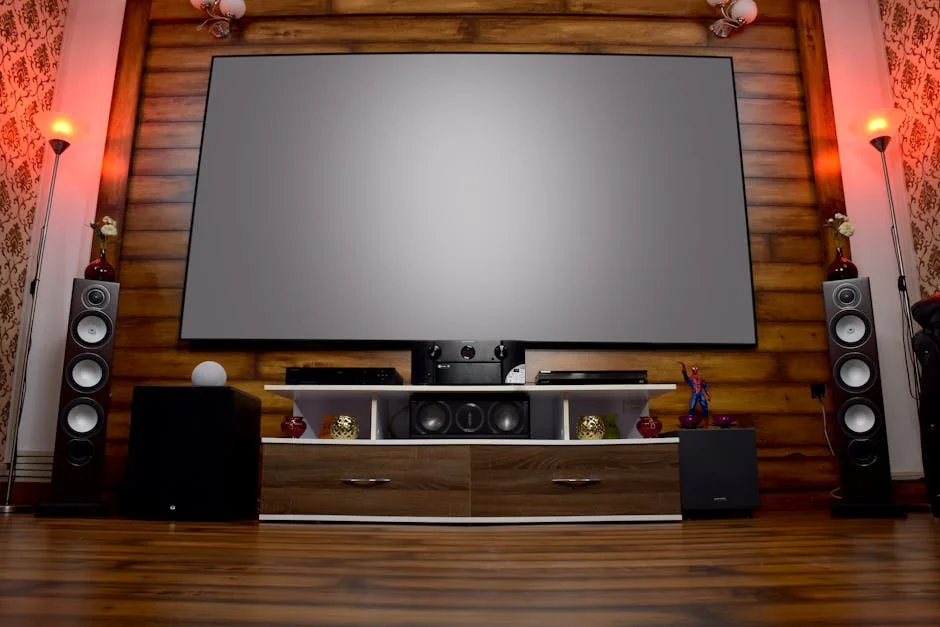
The Klipsch Reference Premiere RP-600M II is the direct successor to the RP-600M — the bookshelf speaker running front left/right duty in this room — and the spec sheet reflects a meaningful revision. Driver configuration is a 6.5-inch Cerametallic woofer paired with a 1-inch titanium tweeter on the same Tractrix horn geometry as the towers. Sensitivity is 96 dB at 1W/1m, impedance is rated at 8 ohms. Klipsch’s recommended amplifier power range is 75, 200 watts, making it compatible with virtually every AV receiver in the mid-tier category.
The RP-600M II’s application in a 5.1.2 system is most natural as the front left/right pair in rooms where towers are unnecessary or impractical — dedicated rooms under 14 feet of seating distance, treated spaces where bass management via subwoofer is dialed in, or any setup where stand-mounting bookshelves positions the tweeter at ear level.
As surrounds, the RP-600M II is technically overbuilt — a smaller bookshelf handles surround duty well, and the budget is better directed toward the front stage and center. The RP-500M is the more appropriate surround choice from the same line. The RP-600M II earns its place at the front. Buyers evaluating the broader field of bookshelf options for the front stage will find useful comparisons in the best bookshelf speakers for home theater coverage on this site.
Check current price on Amazon.
Klipsch Reference Premiere RP-504C II Center Channel Speaker
The center channel carries dialogue — which means it carries roughly 60, 70 percent of a film’s audio information by time. Matching it to the front left/right pair is not optional; it is the most audible single decision in a surround build. The Klipsch Reference Premiere RP-504C II uses a dual 5.25-inch Cerametallic woofer array flanking a 1-inch titanium tweeter on a Tractrix horn — the same horn geometry as the RP-600M II and RP-6000F II, which is precisely the point. Sensitivity is 96 dB, impedance 8 ohms nominal, and recommended amplifier power sits at 75, 200 watts.
The RP-504C II is the step up from the RP-504C, which itself was the recommended center match for the original RP-600M. Whether the crossover changes represent a meaningful audible improvement over the original depends on the room; the spec sheet changes are real, the audible delta in treated rooms is described by owners as modest but genuine on critical listening material.
For a component-built 5.1.2 system using RP-6000F II towers or RP-600M II bookshelves at the front, the RP-504C II is the correct center match. The best center channel speaker comparisons on this site cover alternatives from Polk, Focal, and others for buyers weighing cross-brand options — but within the Klipsch Reference Premiere ecosystem, this is the center to buy.
Check current price on Amazon.
Klipsch Reference R-41SA Dolby Atmos Elevation Speaker Set
The height layer in a 5.1.2 system is where many buyers underinvest, then wonder why their Atmos overhead effects sound vague. The Klipsch Reference R-41SA is an elevation speaker designed to fire upward from the top of an existing speaker — either a bookshelf or a floorstander — bouncing sound off the ceiling to create the height channel. The set ships as two pairs (four speakers total), covering both left and right Atmos height positions. Driver configuration is a single 4-inch woofer with a 0.75-inch tweeter on a 90-degree Tractrix horn per speaker, angled at approximately 35 degrees from horizontal. Sensitivity is 93 dB, impedance 8 ohms, recommended amplifier power 10, 125 watts.
The R-41SA belongs in the same Reference family as the R-625FA, R-52C, and R-41M in the bundle above — making it a natural expansion path if a buyer starts with the all-in-one system and wants to add height channels later, or wants a dedicated elevation solution rather than using the R-625FA’s integrated upward-firing driver. The 93 dB sensitivity is lower than the Reference Premiere pieces but still well above the threshold where a mid-tier receiver will clip before reaching listening levels.
Ceiling height matters for elevation speakers. The bounce-off-the-ceiling approach works best with flat ceilings in the 8, 10 foot range — the range where the reflected angle lands near the listening position. Vaulted ceilings, cathedral ceilings, or rooms with exposed beams diffuse the reflection enough that in-ceiling speakers become the stronger engineering choice.
Check current price on Amazon.
Buying Guide
How Many Speakers Do You Actually Need to Install
A 5.1.2 system requires seven discrete speaker positions: front left, center, front right, surround left, surround right, and two height channels. The subwoofer is channel eight. The height channels can be handled three ways — dedicated in-ceiling speakers, add-on elevation speakers that sit atop existing speakers and fire upward, or integrated floorstanding speakers with built-in upward-firing drivers like the R-625FA. Each approach involves a different installation trade-off, and the right answer depends on ceiling type and whether you can run wire to the ceiling.
In-ceiling placement wins on localization accuracy. Elevation speakers win on installation convenience. Integrated towers win if you want a single purchase that covers everything. Understanding which constraint governs your room determines which path to take before evaluating any specific product.
Matching Impedance to Your Receiver
Every speaker in the list above carries an 8-ohm nominal impedance rating. Most AV receivers are rated to drive 8-ohm loads without issue and can handle 6-ohm loads with minor power reduction. A few mid-tier receivers are rated for 4-ohm loads on all channels, which provides more headroom. The practical concern is not impedance in isolation but impedance combined with the number of channels you are driving simultaneously.
A 7-channel receiver driving seven speakers at once sees more sustained thermal load than a 5-channel configuration. Mid-tier receivers in the 80, 100 watt-per-channel range handle the Klipsch Reference Premiere lineup without issue because of the high sensitivity — less amplifier power is required to reach the same output. Checking your receiver’s minimum impedance rating before selecting speakers is a five-minute step that prevents compatibility issues.
Crossover Settings and Bass Management
The THX standard for the main crossover in a home theater system is 80 Hz — all speakers crossed over to the subwoofer at that frequency, with the LFE channel added below. Audyssey MultEQ XT32 defaults to this and adjusts it per speaker based on measurement. For bookshelves like the RP-600M II, an 80 Hz crossover is appropriate. For towers like the RP-6000F II, some builders prefer 60 Hz or 80 Hz depending on how low the tower’s usable bass extends in the actual room.
The subwoofer’s role is to handle everything below the crossover point cleanly and at high output levels. An underpowered or incorrectly placed subwoofer is the most common reason a capable main speaker array disappoints. Place the subwoofer first, measure with REW, dial in the crossover, then evaluate the main speaker array. Sequence matters.
Budget Allocation Across a Five-to-Seven Speaker System
The front stage — left, center, right — deserves the largest share of the budget. This is where dialogue lives and where most critical listening content originates. The surround channels matter for immersion but are far less demanding than the front stage in terms of output and resolution requirements. Height channels are the last priority in terms of audio resolution, though they carry significant spatial information.
A reasonable allocation for a component-based build is roughly 50 percent of the speaker budget to the front three, 25 percent to the surrounds, and 25 percent to the height channels. The subwoofer budget is separate. Buyers constrained to a single purchase covering all seven channels plus a subwoofer will find the Reference bundle a more practical starting point than buying components individually — reviewing the home theater speakers under two thousand dollars options alongside the bundle helps establish what a component build at the same ceiling actually costs.
In-Ceiling Versus Elevation Speakers for the Height Layer
This is a decision that depends on three variables: ceiling construction, ceiling height, and tolerance for installation work. In-ceiling speakers require cutting holes, running speaker wire through wall cavities or along molding, and either attic access or an in-wall fishing process. Elevation speakers require a flat surface to sit on and two speaker cable runs to whatever surface they occupy. The installation difference is substantial.
The localization difference is also real but room-dependent. In a flat 8, 9 foot ceiling, elevation speakers perform well enough that most listeners cannot identify the source as reflected versus direct. Browse the full range of speaker options, particularly for height channels, before deciding — the R-41SA is a strong elevation choice, but in-ceiling placement remains the engineering-correct answer for buyers with ceiling access.

Frequently Asked Questions
Can I mix Reference and Reference Premiere speakers in the same 5.1.2 system?
Mixing Reference and Reference Premiere in the same system introduces tonal mismatches that are audible on panning content. Both lines use Tractrix horns and titanium tweeters, but the cabinet voicing, crossover tuning, and driver materials differ enough that trained listeners notice the inconsistency. The safer approach is staying within one line for the front three channels — center and left/right matched — and accepting minor variation only at the surrounds and height positions, where localization expectations are less precise.
Do the R-625FA’s built-in Atmos drivers work as well as separate elevation speakers?
The R-625FA’s built-in approach works and is clearly audible as a height layer, but the spatial precision of a discrete Klipsch Reference R-41SA or in-ceiling speaker is generally better. For buyers who cannot install dedicated height speakers, the integrated approach is the right practical solution. For buyers who can, separate elevation or in-ceiling speakers are worth the additional complexity.
What AV receiver do I need to power a full 5.1.2 Klipsch Reference Premiere system?
Because the Reference Premiere line runs 95, 98 dB sensitivity, a 7-channel receiver in the 80, 100 watts-per-channel class handles the full system without clipping at realistic listening levels. The sensitivity advantage means you are not buying receiver headroom to compensate for inefficient speakers.
Is the R-12SW subwoofer in the Reference bundle enough for a dedicated theater room?
In a larger room or for buyers who prioritize deep bass extension below 25 Hz, a dedicated subwoofer upgrade — SVS PB-1000 Pro, HSU VTF-2 MK5, or equivalent — produces meaningfully better results. The subwoofer is the most room-dependent component in any home theater system. Running a calibration measurement after placement reveals whether the existing unit is adequate for the specific space.
Should the height channels in a 5.1.2 system be the same brand as the main speakers?
Tonal matching at the height layer is less critical than at the front three channels because height effects are primarily spatial and ambient rather than dialogue-carrying or effect-localized. That said, staying within the same line simplifies the receiver’s bass management calibration and avoids obvious sensitivity mismatches. The R-41SA at 93 dB sensitivity pairs naturally with Reference Premiere main speakers at 95, 98 dB — Audyssey will trim the level difference during calibration, but the gap is small enough not to cause problems.
Where to Buy
- Klipsch Reference 5.1 Dolby Atmos Home Theater System with R-625FA Floorstanding Speakers, R-52C Center, R-41M Surrounds & R-12SW 12" Powered Subwoofer, Black (Speaker System + Subwoofer) (Best overall)See price on Amazon
- Klipsch Reference Premiere RP-6000F II Floorstanding Speaker, WalnutSee price on Amazon
- Klipsch Reference Premiere RP-600M II Ebony Bookshelf SpeakersSee price on Amazon
- Klipsch Reference Premiere RP-504C II Ebony Center Channel SpeakerSee price on Amazon
- Klipsch Reference R-41SA Dolby Atmos High-Performance, Horn-Loaded Elevation Surround Speaker Set (2 Pairs, 4 Speakers)See price on Amazon